The Electric Violin
Effects Pedal Guide
I am an Amazon associate. If you purchase via included links, I may receive a small commission. FWIW, I bought and tested all the gear in this guide myself. No sponsors, no BS.
Free Introductory LessonsWhy Guitar Pedal Advice Fails Violinists
If you're like me, you've seen someone play or write about a guitar pedal, or heard your favorite song and wanted to create the signature sound yourself — only to plug in and be horrified. You're not alone.
Here's the problem: 90% of effects pedal content is created by guitarists, for guitarists. We share the same pedals, and even some of the same strings, but we don't share the same signal.
Most electric guitars use magnetic pickups; most electric violins use piezo pickups.
Base-model electric violin spans 196 Hz (G3) to 3,520 Hz (A7), with extended ranges going far lower. Guitar typically covers 82 Hz (E2) to 1,175 Hz (D6).
Piezo pickups have high-impedance output that behaves differently with effects circuits than a magnetic pickup's signal.
Violin bowing creates different attack and sustain characteristics than guitar picking.
Good news: once you understand the science behind why certain pedals work for violin, you can make informed decisions instead of expensive mistakes. I've spent 20+ years playing electric violin professionally in bands and on recordings, tested over 150 effects pedals, and evaluated 11 different electric violin models. This guide takes everything I've learned and gives you my practical recommendations — from painful lessons — you can use immediately.
The Foundation: Why Preamp/EQ Matters More for Violin
Before we talk about reverb, delay, or any creative effects, we need to talk about the most important piece of your signal chain: your preamp and EQ. It's the one piece of gear I wish I had purchased first, and it has made the biggest difference in my playing. I won't play without it.
Piezo pickups — found in most electric violins — have two characteristics that affect everything downstream. First, high-impedance output that can cause tone loss and interference. Second, an uneven frequency response that emphasizes certain overtones, often making the E-string piercing or the lower strings muddy.
A quality preamp solves both problems: it converts your high-impedance signal to low-impedance (impedance matching), and it gives you EQ controls to shape your frequency response before it hits your effects pedals. Think of it this way — if your raw violin tone isn't balanced and clear, no amount of reverb or delay will fix it. You'll just be adding beautiful effects to an unbalanced sound, and make it harder to diagnose what isn't working (ask me how I know 😬).
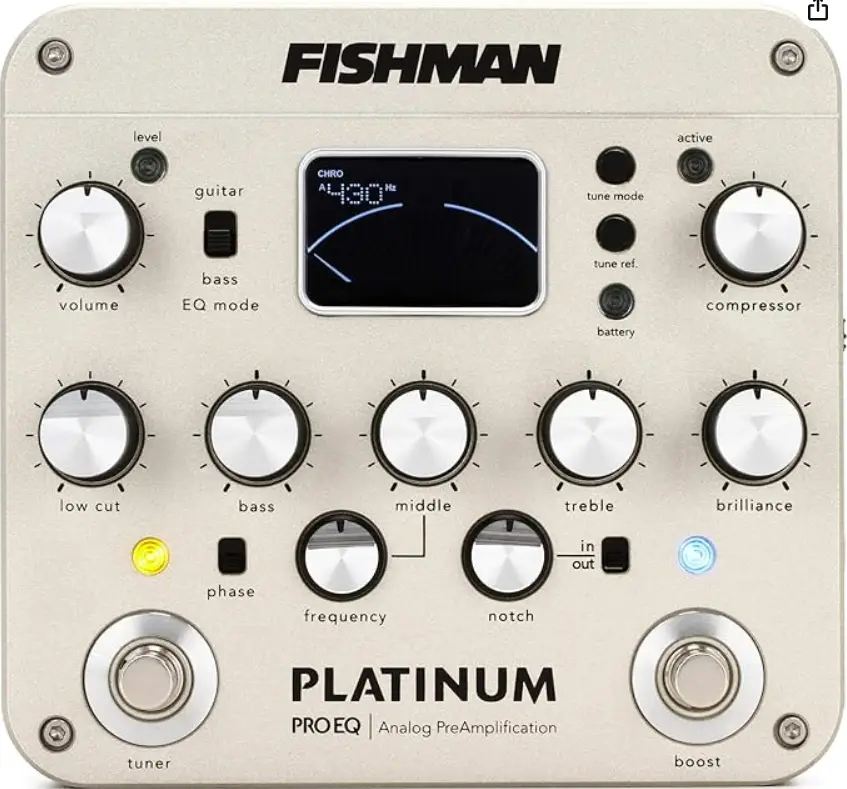
Fishman Platinum Pro EQ
Professional-grade impedance matching + parametric EQ + compression.
- Extended mid-range control: critical for the lower three strings of a 4-string violin, even more important for 5, 6, and 7-string instruments
- Built-in compression: evens out piercing or scratchy tones from piezo pickups, especially on the E-string
- Professional-grade impedance matching: ensures your signal plays well with everything downstream
- Parametric EQ bands: surgical frequency shaping that simple tone controls can't match
Cost note: it's expensive, even used (typically $250–350). But it's solving multiple problems at once — preamp, compression, and sophisticated EQ. I probably wasted more than $1,000 on pedals over the years that I thought didn't work with my instrument, when in reality it was compounding impedance mismatch, bad or no EQ, and volume spikes.
Get the Fishman Platinum Pro EQ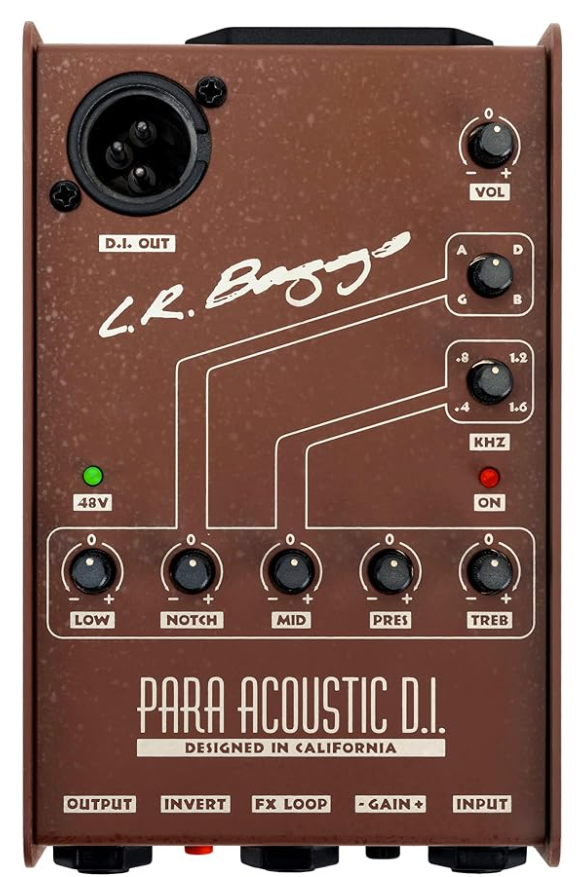
L.R. Baggs Para Acoustic DI
If the Fishman is outside your budget, the L.R. Baggs Para Acoustic DI (typically $180–220) is highly regarded in the violin community. I haven't personally tested it, but I consistently hear positive feedback from players.
- Quality preamp/DI functionality
- 5-band EQ — less extensive than Fishman, but still useful
- Notch filter for feedback control, helpful for acoustic-electric violins
- Solid impedance matching
Trade-off: less mid-range control and no built-in compression, but still a significant upgrade over plugging directly into effects pedals.
Shop L.R. Baggs Para DI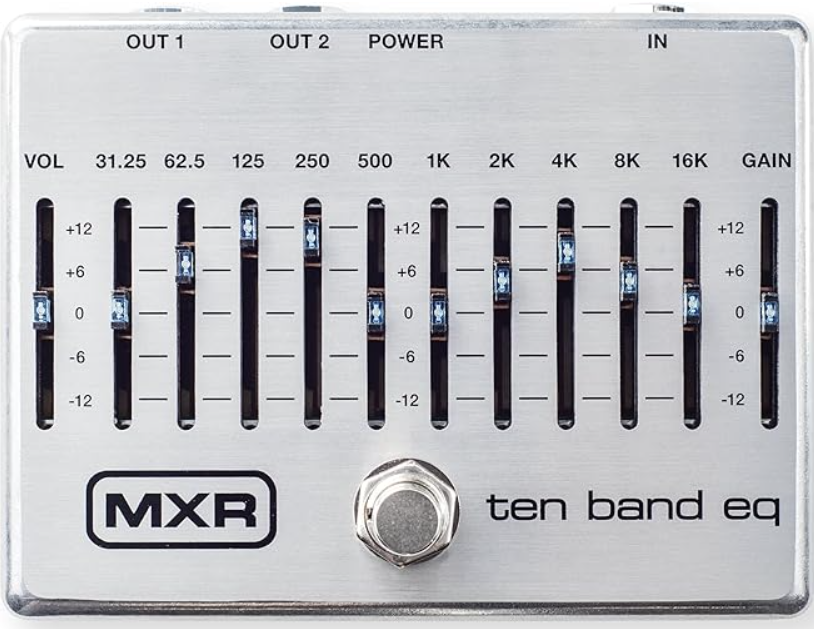
MXR 10-Band Graphic EQ
For recording or advanced tone shaping, I personally run an MXR 10-Band EQ after my Fishman Platinum. This might seem redundant, but here's why it works.
- Fishman shapes your fundamental tone — fixing piezo issues, setting your base sound
- The graphic EQ makes surgical adjustments for specific performance contexts or recording situations
- More strings = more EQ needs: if you play 5, 6, or 7-string violin, the additional bands become increasingly valuable for balancing your extended range
The Science of Pedal Selection
Before I give you specific pedal recommendations, let's talk about how to think about pedals for violin. I wish I had known this twenty years ago, and it will serve you far into your musical future.
The Three Critical Factors
Impedance Matching
High-impedance piezo output can cause tone loss through long cable runs, interference and noise, and incompatibility with pedals designed for low-impedance guitar pickups. Solution: start with a quality preamp/DI that converts your signal to low impedance.
Frequency Response
Guitar pedals are often voiced for guitar frequencies — heavy on mids, less extended highs. Some sound shrill or harsh on violin. Ask: does the pedal preserve your violin's clarity in the upper register? Does it muddy your lower strings?
Pickup Type
Beyond piezo vs. magnetic, consider passive vs. active pickups (output level and impedance), bridge vs. body-mounted pickups (tonal character), and pickup quality — cheap piezos are harsher, requiring more corrective EQ.
The key insight: there's no single "right" pedal for all electric violins. The science helps you understand why a pedal works — or doesn't — with your specific instrument.
Analog vs. Digital: What You Need to Know
Analog Pedals
- Often have "character" and warmth
- Can be finicky with piezo signals
- Typically less versatile — one sound per pedal
Digital Pedals
- More consistent with piezo pickups
- Greater versatility — multiple effects, presets
- Better frequency range handling
My approach: I use both. Digital for versatility and reliability, analog for unique or especially warm sounds and tones.
Essential Effects — What Actually Works
Now that you understand the foundation, let me share the effects that were in my first live rig. They were all in my Boss ME-50, and that's how I was able to experiment so much and learn about sound — what different effects did to shape it, how they interacted with each other. The science came later, but these effects taught me how to listen and what was possible.
Compression
Violin bowing creates natural volume inconsistencies — and performance anxiety doesn't help. Add the natural characteristics of piezo pickups, and you get harsh, piercing notes (especially the E-string), volume jumps between strings, and scratchy transients from bow attacks. Compression evens out these inconsistencies without squashing your dynamics.
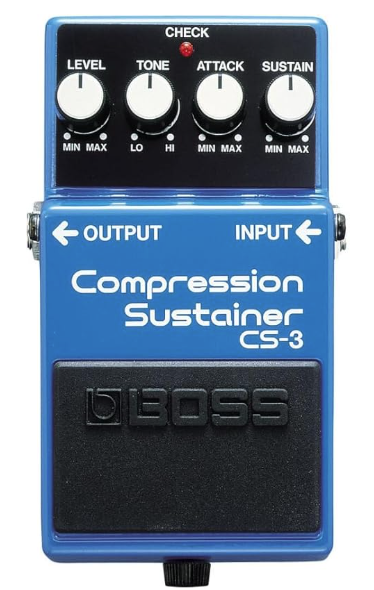
Boss Compression Sustainer (CS-3)
My recommendation. A tried-and-true design that works well with piezo signals, with transparent compression that preserves violin overtones — affordable and reliable.
Alternative: the Fishman Platinum EQ's built-in compression is excellent — if you have that preamp, you might not need a separate compressor for basic applications.
Shop Boss CS-3Budget option: the Boss ME-50 Multi-Effects ($150–200 used) includes Boss compression plus 15+ other effects. If you're starting out and want to experiment affordably, this is an incredible value — I still own and use the same one I bought 17 years ago.
Find the Boss ME-50Reverb
Electric violin can sound dry and lifeless without reverb. When I'm performing or recording, reverb gives me spatial dimension and depth, the feeling of natural resonance that acoustic instruments get from their bodies, and the foundation to set musical context and build atmosphere.
My favorite experiences: the Line 6 Verbzilla (Green reverb setting) gives lush, ambient reverb that works beautifully for experimental playing and soundscapes. The EarthQuaker Devices Astral Destiny — a modulated reverb with a stretch function — is currently on my performance board and perfect for ambient and textural playing.
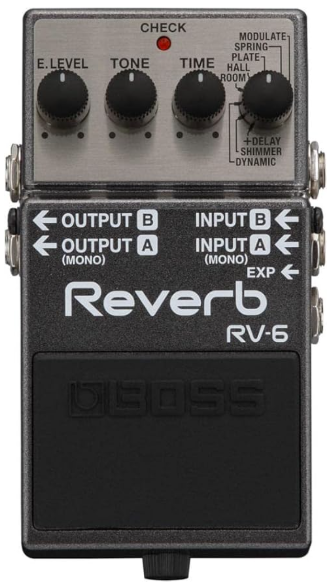
Boss RV-6
Classic Boss quality, multiple reverb types. (Also consider the TC Electronic Hall of Fame 2 — versatile, affordable, sounds great on violin.)
Delay
Delay adds rhythmic interest and space to your playing. It's especially effective for creating texture in ambient music, rhythmic echoes in contemporary styles, and filling space in solo performance.
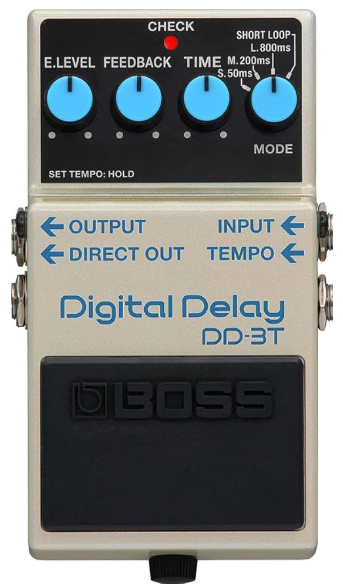
Boss DD-Series (DD-7, DD-8, or DD-200)
My recommendation. Reliable digital delays that handle piezo signals well, with clean repeats that don't muddy your tone and tap-tempo functionality — essential for live performance.
Experiment with: dotted-eighth-note delays for interesting rhythmic patterns, shorter slapback delays for rockabilly vibes, longer ambient delays for soundscapes — my personal favorite.
Find the Boss Digital DelayChorus
Chorus creates a subtle doubling effect that can thicken your sound, add shimmer to sustained notes, and create the illusion of multiple violins.
My recommendation: Boss CH-1 Super Chorus. A classic, reliable chorus that works with any signal, with simple controls that are easy to dial in and an affordable price. I'm currently testing the MXR Analog Chorus and will update my recommendations as I evaluate it.
Overdrive, Distortion & Fuzz
Gain effects let you add aggression and edge to rock/metal playing, create sustain and singing leads, and access entirely new sonic territories.
I cut my teeth on gain effects using the Boss Metal Zone (MT-2), which I loved for aggressive distortion as a rhythm violinist in a 3-person post-punk band fronted by a bassist. Since then, I've explored 15+ different overdrive options in my Boss ME-50, HeadRush Prime, and individual pedals — my current performance board includes the EarthQuaker Plumes (overdrive) and EarthQuaker Zoar (heavier distortion).
- Less is often more: violin's high frequencies can become harsh with too much gain
- Use EQ aggressively: cut high-end, shape mids to avoid shrillness
- Start with overdrive: don't jump straight to heavy distortion or fuzz
Budget starting point: the Boss ME-50 gives you access to multiple Boss overdrives and distortions to experiment with before investing in individual pedals.
Your First Pedalboard — The Starter Signal Chain
You don't need 15 pedals to get started. Here are the pedals I wish I had started with and mastered first — it would have saved time, money, and sanity.
2 Pedals
- Fishman Pro Platinum EQ → your amp/interface
This alone transforms your electric violin sound: fixing impedance issues, balancing frequency response, adding compression to even out dynamics.
4–5 Pedals
- Fishman Pro Platinum EQ (foundation)
- Boss CS-3 Compression (if not using Fishman's)
- Boss SD-1 Super Overdrive (optional)
- Boss DD-7/DD-8 Delay
- TC Hall of Fame 2 or Boss RV-6 Reverb
Alternative Path
- Fishman Pro Platinum EQ → Boss ME-50 Multi-Effects → amp/interface
The ME-50 gives you compression, overdrive, chorus, delay, and reverb — multiple Boss effects to experiment with, all-in-one for ~$150–200 used.
Why this order: EQ/preamp first fixes signal issues; compression second evens out dynamics; gain effects third, if used, come before modulation; delay and reverb last, since time-based effects belong at the end.
Where You Can Go — Advanced Concepts
Once you have the foundational pedals and understanding, your creative possibilities expand dramatically. I've found more creative freedom and joy in using existing pedals and making smart choices in getting new pedals because I understand the basics so much better now.
My Current Performance Board ("The Weird Board")
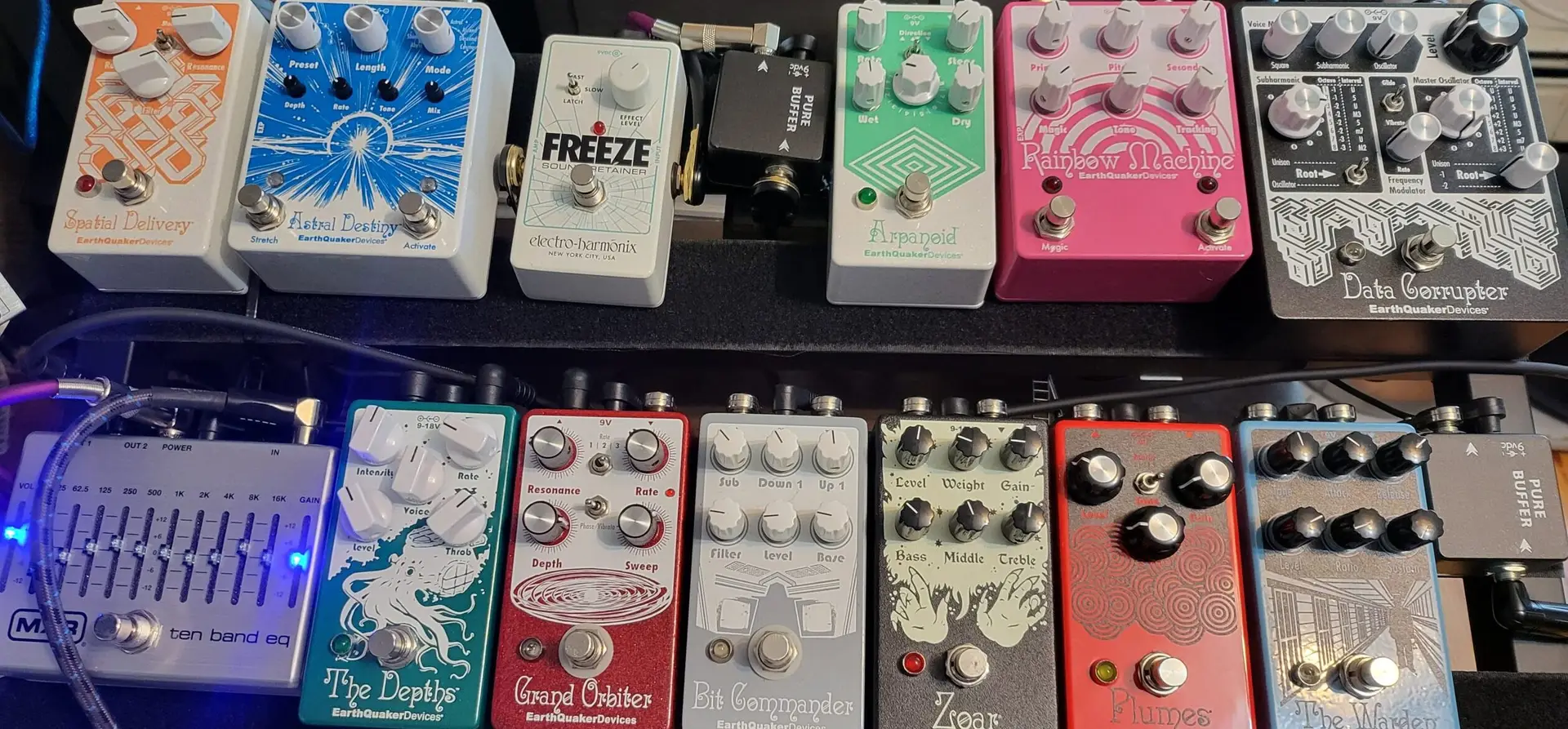
Here's what I use for ambient/experimental performance, in signal order:
- 1. Fishman Pro Platinum EQ (foundation)
- 2. MXR 10-Band EQ (surgical tone shaping)
- 3. EarthQuaker The Warden (advanced compression)
- 4. EarthQuaker Plumes (overdrive)
- 5. EarthQuaker Zoar (distortion)
- 6. EarthQuaker Commander (boost/buffer)
- 7. EarthQuaker Grand Orbiter (phaser)
- 8. EarthQuaker The Depths (vibe/chorus)
- 9. EarthQuaker Spatial Delivery (envelope filter)
- 10. EarthQuaker Astral Destiny (modulated reverb)
- 11. Electro-Harmonix Freeze (sound-on-sound)
- 12. Pure Buffer (signal integrity)
- 13. EarthQuaker Arpanoid (arpeggiator)
- 14. EarthQuaker Rainbow Machine (pitch shifter)
- 15. Data Corruptor (glitch/harmonizer)
Multi-Effects Processors
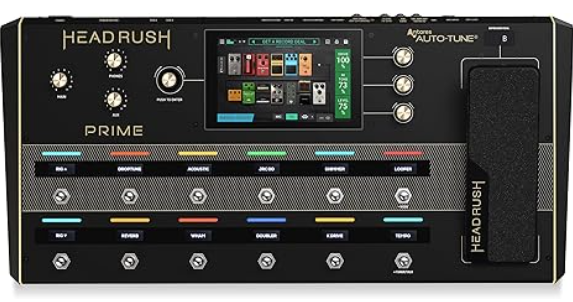
HeadRush Prime
Amp and cabinet modeling, experimenting with effects combinations without buying more pedals, creating more "standard" electric violin tones, and quick preset changes in performance.
Shop HeadRush Prime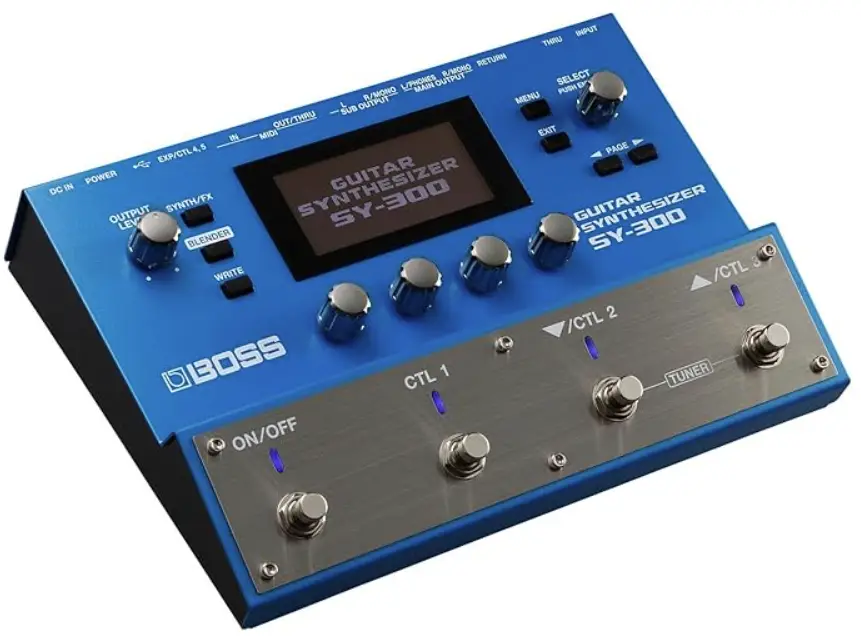
Boss SY-300 Guitar Synthesizer
Generate and customize synthesized tones, layer synth sounds with your natural violin tone, and create sounds impossible with traditional effects.
Shop Boss SY-300The key principle: you don't need everything I have. Nail the essentials, learn your sound, add only what serves your music.
Key Takeaways — The Science of Smart Choices
Start with the foundation: invest in a quality preamp/EQ first (Fishman Platinum or L.R. Baggs Para Acoustic).
Understand the science: impedance, frequency response, and pickup type determine what works best for you and your sound.
Signal chain order matters: preamp/EQ → compression → gain → modulation → delay → reverb.
Test before you buy: if possible, try pedals with your specific violin before purchasing.
Budget-smart experimentation: the Boss ME-50 offers incredible value for exploring sounds.
More strings = more EQ: extended-range instruments benefit from additional EQ bands, and you'll hear the difference.
Digital isn't inferior: modern digital effects handle piezo signals at least as well as vintage analog, with far more flexibility.
Less gain = more clarity: violin's high frequencies require careful gain staging, especially with overdrive or distortion.
Your ears are the final judge. These are guidelines, not rules — if you're creating the art you intend to make, that's what matters.
Shopping List by Budget
~$450–500
- Boss ME-50 Multi-Effects (used)
- Fishman Pro Platinum EQ
~$600–800
- Fishman Pro Platinum EQ
- Boss CS-3 Compression
- Boss DD-7 Delay
- TC Electronic Hall of Fame 2 Reverb
~$1,200–1,500
- Fishman Pro Platinum EQ
- MXR 10-Band EQ
- EQD The Warden (compression)
- EQD Plumes (overdrive)
- Boss DD-8 (delay)
- EQD Astral Destiny (reverb)
Master Electric Violin
Effects, Live.
Subscribe for Free Workshops and Resources